Building My Homelab
From CCNA Practice to a Realistic Infrastructure
For the past two months, I have been practicing networking labs on GNS3 and Packet Tracer as part of my CCNA 200-301 preparation. I worked on many topics: VLSM subnetting, VLAN configuration, static routing, STP, and different enterprise network topologies.
GNS3 is an excellent tool to learn network logic and work with virtual Cisco devices. However, something important was missing: the experience of building a full infrastructure with Windows and Linux servers, Active Directory, file sharing, monitoring, network segmentation, and real system administration tasks.
To go further, I decided to build my own homelab. My goal is simple: create a small but realistic enterprise environment to practice both networking and system administration.
My current work environment
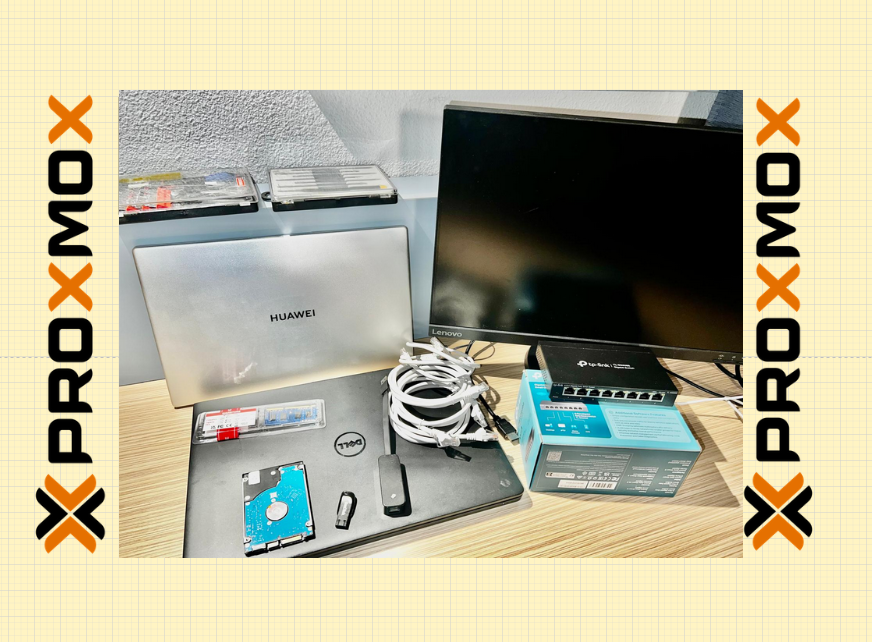
Main laptop: Huawei D15
This laptop is my main workstation and my administration machine.
It runs in dual boot:
Windows 11
Used for:
- Networking labs (Packet Tracer, GNS3)
- Video recording (OBS Studio)
- Video editing
Ubuntu 24.04 (main OS)
Used for:
- Full-stack development
- School projects (C++, R, AI projects)
- Daily work
I do not want to run heavy virtual machines on this laptop. It should remain fast, stable, and dedicated to administration.
Hardware purchased for the homelab
Main server: Dell Latitude 3570
I bought this laptop second-hand and turned it into a dedicated Proxmox server.
Original specs:
- Intel Core i3-6006U (2 cores / 4 threads)
- 4 GB DDR4 RAM
- 256 GB HDD
Upgrades:
- Upgraded to 16 GB RAM (2×8 GB)
- Replaced the HDD with a 512 GB SATA SSD
This server is now the foundation of my virtual infrastructure.
Network infrastructure
Managed switch: TP-Link TL-SG108E
- 8× Gigabit Ethernet ports
- Supports VLAN tagging (802.1Q)
- QoS features
- Web management interface
It will be used to structure the homelab network, especially VLAN segmentation and service separation.
Cables and accessories
- Several RJ45 Cat6 cables
- A TP-Link USB-to-Ethernet adapter for the Huawei laptop
This will be the foundation for building a complete enterprise-style environment (AD DS, DNS, DHCP, Linux servers, monitoring, advanced segmentation, and more).